
Mulleres na Lexicografía
Klara Hechtenberg Collitz (née Klara Hechtenberg)
German, English, French, Italian, Spanish, Latin and Greek
1863 (Rheydt bei Mönchengladbach, Germany) – 1944 (Baltimore, USA) Klara Hechtenberg was born in Germany, even though her youth was characterized by numerous trips and stays in different European countries at the end of the 19th century. In particular, she lived for a year and a half in Lausanne (Switzerland), where she managed to improve her command of the French language. Later, she moved to Oxford (UK) in order to complete her BA and then she started working there as a lecturer. After this initial period as university lecturer, she returned to Germany in order to complete her PhD. Shortly after she met her future husband, Hermann Collitz, with whom she emigrated to the USA. After their marriage, she stopped working as a lecturer at the university, although she continued participating in conferences and publishing relevant scientific papers.
She studied her BA in Philology at the University of Oxford and worked as a lecturer at various universities in the UK. Afterwards, she returned to Germany to complete and defend her PhD dissertation at the University of Heidelberg, carried out under the supervision of Professor and Medievalist Wilhelm Braune. This initial period of her academic and professional life was marked by her participation as lecturer at various universities in the UK as well as in Germany. Not only taught she German language and linguistics, but also Romance philology. She had an active participation within the Linguistic Society of America and her lexicographical work focused particularly on the analysis of foreign words and borrowings.
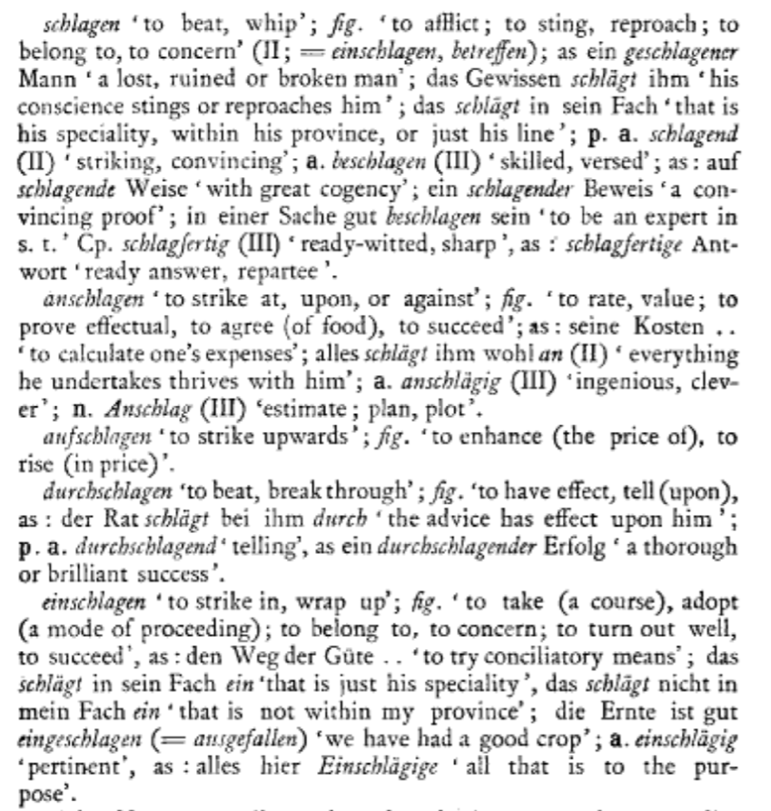
Das Fremdwort bei Grimmelshausen: ein beitrag zur fremdwörterfrage des 17. jahrhunderts (“Foreign words in Grimmelshausen: a contribution to the question of foreign words in the 17th century”) (1901). This PhD dissertation offers a statistical account of the foreign words occurring in some of Grimmelhausen’s works. The analyzed lexical units are etymologically determined according to a serious of previous delimited parameters. Fremdwörterbuch des 17. Jahrhunderts (“Dictionary of foreing words of the 17th century”) (1904). This is a lexicological and lexicographical work that collects the most frequently used foreign words based on a corpus which consists of a series of letters and texts written in the 17th century. It describes general trends regarding the use of foreign words in different European languages. Verbs of motion and their semantic divergence (1931) Lexicographical work containing lists of verbs in different languages. The aim of this work was to explain the semantic expansion and the figurative use some verbs of motion have, paying special attention to meanings related to the notions of propriety and suitability.
Verbs of motion and their semantic divergence (1931): This work, published in Language 7(1) can be consulted on the following link: https://www.jstor.org/stable/522018?seq=15#metadata_info_tab_contents
Klara Hechtenberg attended the founding assembly of the Linguistic Society of America (LSA), becoming an active member in 1928 until her death. Before her death, she donated part of her fortune to the LSA for the creation of a Professorship in Contrastive Linguistics, also known as the Hermann and Clara H. Collitz Professorship at the University of California, Santa Barbara.
1. Bibliography Falk, J. (2014). Women, language and linguistics: three American stories from the first half of the twentieth century. Routledge. McLelland, N. (2022). Women in the history of lexicography. An overview, and the case of German. En Proceedings of the XX EURALEX Congress, pp. 53-70. 2. Lexicographic works Hechtenberg Collitz, K. (1901). Das fremdwort bei Grimmelshausen: ein beitrag zur fremdwörterfrage des 17. jahrhunderts. Universidade de Heidelberg. Hechtenberg Collitz, K. (1904). Fremdwörterbuch des 17. jahrhunderts. B. Behr. Hechtenberg Collitz, K. (1931). Verbs of motion and their semantic divergence. En Language 7(1), pp. 5-118.
Iván Arias Arias
María José Domínguez Vázquez (dir), Lola Mosquera Sánchez, Deborah Chidimma Nebechukwu, U-Tong Sih - EMLex (autor@s do deseño e estrutura do dicionario). 2022. Mulleres na Lexicografía. En Fernández Rei, Elisa & Álvarez de la Granja, María (coords.), Lingua viva. Santiago de Compostela: Instituto da Lingua Galega. ilg.usc.gal/linguaviva [Consultado o 31/08/2026 ás 10:35].
Este dicionario está dispoñible baixo licenza Creative Commons Atribución 4.0 Internacional.
Inicia sesión para deixar un comentario.